A Manifesto for Women's Collective Self-Governance
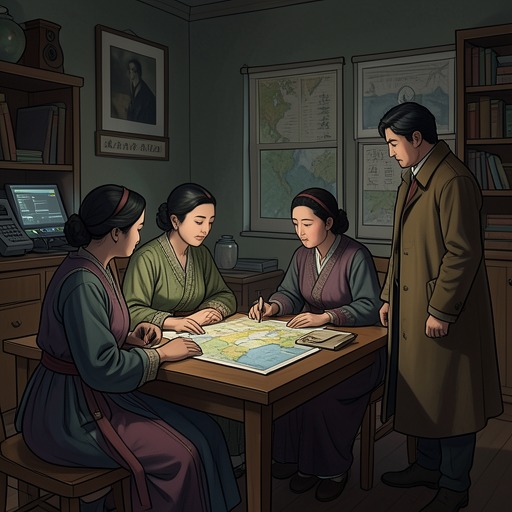
Women TalkingA Manifesto for Women's Collective Self-Governance is Ona Friesen’s proposed framework for deciding what the women of Molotschna would seek to establish, rather than merely what they would oppose. Raised during debate about staying and fighting, it turns the prospect of resistance into a question of political design: who would make decisions, what knowledge women and girls could gain, and what kind of religious and communal life could follow. The evidence presents a proposal and a set of principles, not a completed manifesto. Its force lies in making the women’s future an object they can describe and deliberate over for themselves.
From grievance to a vision of life
Ona Friesen asks whether the women should identify what they are fighting for before listing the advantages and costs of staying to fight. Mariche Loewen initially names safety and freedom from attacks as the immediate aims. Ona accepts their urgency but argues that these aims need a more specific account: a manifesto or revolutionary statement could describe the conditions of life the women would require after a victory, as well as the actions needed to achieve and sustain them. The proposal therefore widens the debate beyond defeating a threat. It asks what would replace the conditions that made women vulnerable.
The urgency behind that question is concrete. Since 2005, attacks had afflicted nearly every girl and woman in the colony. Women had been made unconscious at night with an animal anesthetic, and awoke without knowing what had happened to them. The assailants, initially believed by many to be supernatural beings, were eventually identified as eight men from Molotschna, some close relatives of the women. The prospect that the women might be required to forgive the accused men, or leave the colony, adds a political and spiritual coercion to the immediate danger. In this context, a manifesto gives the women a way to define the terms of a future rather than accept the choices imposed on them.
The proposed community
Ona Friesen sketches a community in which men and women make decisions collectively, women are permitted to think, and girls are taught to read and write. She also proposes placing a world map in the schoolhouse so the women and children can begin to understand their place beyond the colony. A new religion, developed from the old but focused on love, completes the outline. These ideas join political authority, education, geography, and religious practice: autonomy would require not just different rules, but access to knowledge and a voice in interpreting the values by which the community lives.
The manifesto’s concern for children is both a principle and a test of the proposed order. Ona adds that their children must be safe. Agata Friesen later asks how the women would live and support themselves if they left, stressing their inability to read or write or speak the language of their country, their reliance on domestic skills that might not be useful elsewhere, and their lack of a world map. Her questions expose a practical gap between imagining freedom and being equipped to survive it. Education and knowledge of the wider world are therefore not decorative ambitions: they address the women’s material vulnerability and the uncertainties of departure.
Who may know and interpret
The manifesto’s demand that women be allowed to think confronts a structure in which men control public authority and the interpretation of religious teaching. Salome Friesen describes women as excluded from membership in the colony’s governing life, while boys and men are permitted to issue orders, determine women’s fates, and interpret the Bible for them. Her account makes self-government inseparable from the right to speak and to count as a member of the community, rather than as a dependent or commodity.
The dispute over forgiveness reveals the same problem in religious terms. Ona Friesen questions what women can be required to forgive when they were unconscious during the attacks and are denied counseling on the grounds that they were not conscious. She presses the contradiction between being told that women do not know the world and being treated as though that ignorance protects them. Salome Friesen further argues that women cannot verify claims about the Bible when they are unable to read it, and that their submission to husbands is justified to them through those husbands’ own accounts of scripture. She identifies the male handing down of interpretation, rather than an absence of religious principle, as the specific obstacle. Ona’s point that illiteracy weakens women’s position in any negotiation over scripture links the manifesto’s educational aims directly to religious self-determination.
Faith, departure, and practical action
The proposed vision does not treat religious commitment as something the women must simply discard. Agata Friesen argues that pacifism forbids violence and that remaining in Molotschna could place women on a path toward conflict, making the colony a battlefield. She later reasons that leaving would better protect themselves and their children, preserve pacifism, and prevent forgiveness from becoming coerced rather than genuine. The women could also teach their children to pursue love, peace, and forgiveness beyond the expectations of their fathers. In this argument, departure becomes a possible means of living by faith, not necessarily a rejection of it.
The manifesto’s ideals take shape alongside preparations that make action possible. After the meeting, August Epp reports obtaining the co-op safe, a stick of dynamite, and a world map; he has also procured a sextant, though he is unsure whether it will be useful. The map is especially resonant beside Ona Friesen’s proposal that the schoolhouse display one: an instrument of orientation is also a practical resource for women who have been denied knowledge of the world. Meanwhile, Agata Friesen warns that the Koop boys may be waiting to report the women’s departure or prevent it, and may use a false report of fire to draw them south toward the men. The women decide to disregard that deception and head north. The sequence places collective vision beside the risks and resources of its execution. Self-government begins as a description of a different society, but its first test is whether the women can make and carry out decisions together.